


Why Is Tinnitus Worse at Night? 7 Reasons the Ringing Gets Louder When You Try to Sleep
All day the ringing hides behind the noise of life. Then you turn off the light. Here is why tinnitus feels louder at night, and what actually helps.

If your ears ring, you probably know the pattern. During the day the sound fades into the background. Then you turn off the TV, lie down, and the whine, hiss or hum seems to turn itself up. You're not imagining it, and you're far from alone: about 21 million American adults report tinnitus in a given year, according to a large national survey published in JAMA Otolaryngology.
In tinnitus communities online, the same sentence comes up again and again: "It's fine all day. It's bedtime that gets me." Here's why.
1. Silence removes the "mask"
During the day, traffic, conversations and appliances partly cover the ringing. At night the background noise drops close to zero, so your brain has nothing else to listen to. The tinnitus isn't necessarily louder. The contrast is.
2. Your attention has nowhere else to go
Tinnitus is closely linked to attention. When you're busy, your brain filters it. Lying in the dark with nothing to do, the sound becomes the main event. Many people describe "listening for it" without meaning to.
3. Stress and the day's worries catch up
Bedtime is when the to-do list replays. Stress keeps the nervous system alert, and an alert brain is more likely to notice the ringing and to react to it.
4. Your jaw and neck are tense
For many people, tinnitus changes when they clench their teeth or move their neck. A long day of clenching, screen time or physical work can leave the jaw and neck tight at night. (More on this in our guide to tinnitus that changes when you clench your jaw.)
5. Lying down changes the sound
Some people notice the ringing shift when they lie on one side or press an ear into the pillow. Changes in position, pressure and blood flow around the head and neck can change how tinnitus is perceived.
6. A noisy day can leave a louder night
A loud job site, a concert, a lawn mower or a long drive with the window down can cause a temporary spike that shows up once everything else goes quiet.
7. Poor sleep feeds the cycle
Studies find that insomnia is much more common in people with tinnitus: one German analysis of chronic tinnitus patients found insomnia in 76%, and a UK study of 444 patients found it in 69%. Tired brains are less able to filter the sound, which makes the next night harder.
What helps at night
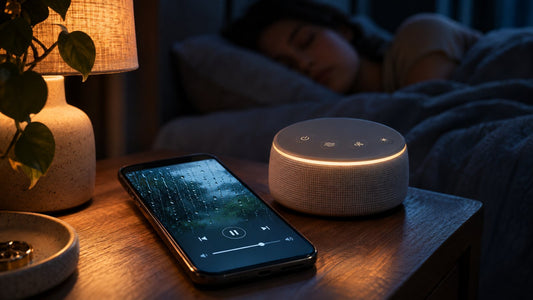
- Don't sleep in total silence. A fan or soft, steady sound reduces the contrast. Keep it just below the level of your tinnitus.
- Give your mind a wind-down cue. The same short routine every night (dim lights, a few slow breaths, a jaw and neck release) tells your body it's time to switch off.
- Relax your jaw and neck before bed. Two minutes of gentle stretches can make a difference if your ringing changes with tension.
- Keep a simple log. Rate the ringing 0–10 each morning for three weeks. Patterns appear quickly: noisy days, late coffee, stressful evenings.
- Talk to a professional if tinnitus is ruining your sleep. The U.S. clinical practice guideline for tinnitus recommends education about management strategies, hearing evaluation when hearing loss is present, and cognitive behavioral therapy for persistent, bothersome tinnitus.
Looking for a calmer bedtime routine?
Quell is a herbal patch you wear behind the ear at night, with a 60-second jaw and neck wind-down routine. Nothing to swallow, charge or switch on.
Sources
- Bhatt JM, Lin HW, Bhattacharyya N. Prevalence, severity, exposures, and treatment patterns of tinnitus in the United States. JAMA Otolaryngol Head Neck Surg, 2016
- Schecklmann M. et al. Psychophysiological associations between chronic tinnitus and sleep, 2015
- Aazh H. et al. Insomnia in patients with tinnitus, J Am Acad Audiol, 2019
- Tunkel DE. et al. Clinical Practice Guideline: Tinnitus. Otolaryngology–Head and Neck Surgery, 2014
This article is for general information and is not medical advice. If your tinnitus is sudden, in one ear only, pulses with your heartbeat, or comes with hearing loss, dizziness or pain, see a doctor promptly.
Keep reading
 caffeine
Caffeine, Alcohol, Salt or Stress? What Really Makes Tinnitus Worse
Should you quit coffee? Here's what research really says about common tinnitus triggers, and a simple way to find your own.
 ear patch
Do Tinnitus Patches Work? An Honest Look at Herbal Ear Patches
Herbal ear patches are everywhere online. Here is what's inside, what they can and can't do, and how people actually use them.
 sleep
White Noise, Fans and TV: Do Sleep Sounds Really Help Tinnitus?
Almost everyone with tinnitus has tried sleeping with the TV on. Here is what actually works with sound at night, and what to avoid.